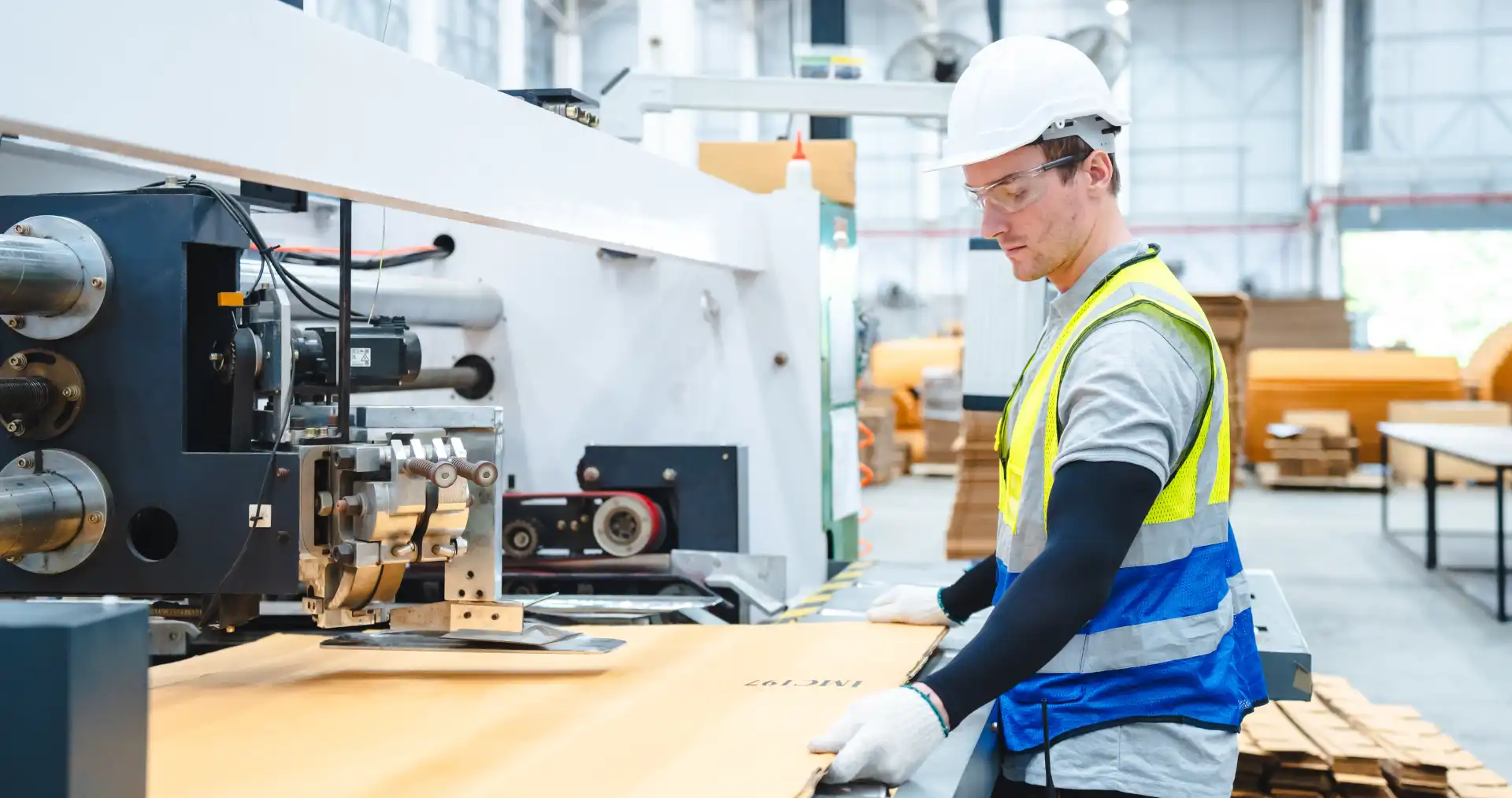

Production floor in the paper and packaging industry
Asseco ERP solve?
Production
Paper and packaging industry

A complete ERP
for manufacturers of paper, packaging,
films and laminates

From raw material, through the production floor, logistics and quality control, to finance, HR and BI analytics, Asseco ERP covers the full operational cycle of a paper and packaging plant. Implemented in Polish plants for more than 25 years.

25+
years of implementations in the paper and packaging industry in Poland
41
technological processes modeled in one system
~4×
growth in production scale without changing the system: the limit is the machinery, not the ERP
100%
records of material consumption per production order
7
functional areas: production, logistics, sales, finance, HR, controlling, BI
Paper production Paper and cardboard packaging Paper hygiene products Stationery Printing and offset printing Converted films and laminates Labels and technical tapes

One system for many paper and board production profiles

Asseco ERP is not a solution tailored to one type of plant. Implementations in plants with different production profiles have given us knowledge that makes our solution more precise than any general-purpose system.

Coated and specialty papers
Production with slitting of parent rolls, coating, calendering. Key: the FIFO roll selection algorithm, roll length records and full batch traceability.
Converted films and laminates
Multilayer film structures, laminating, sealing. Recipe management, control of layer parameters, full records of raw materials per order.
Offset and flexographic packaging
Printing, die-cutting, gluing: dozens of technological operations in one data model. Non-conformity reports, run length control, requirements of the pharmaceutical and cosmetics industries.
Folding cartons and packaging
High-volume production of folding cartons and corrugated board. Production planning backwards from the delivery date, integration with creasing and gluing machines.
Labels and technical tapes
Short runs, many variants, variable grammages. A flexible product catalog, quick creation of new technologies based on existing ones, records of trial orders.
Tubes, cores and molded products
Production of cardboard tubes for winders, cores and spools. Management of roll lengths, dimensions and strength parameters per item code.

Four characteristics of this industry that need dedicated solutions, and that Asseco ERP can handle

Book a call
Raw material in rolls with variable length
Each roll has a different weight and available length. A standard ERP records quantities in pieces or meters and does not understand roll length, grammage or selecting a roll for an order. Asseco ERP runs the FIFO algorithm for selecting parent rolls, records each roll as a separate warehouse object and assigns consumption to a specific order.
Multi-stage technological processes
One package or paper product goes through dozens of operations: printing, varnishing, die-cutting, gluing, hologram application, creasing. In a standard ERP, the technology ends at the bill of materials. In Asseco ERP, each operation has a time, a machine, a standard and actual execution. Implementation plants have handled up to 41 separate technological processes in one system.
The label must identify every unit
Traceability requirements, FSC certificates, ISO 15378 (GMP) and the expectations of pharmaceutical and food customers require identification of every unit, from raw material receipt to the shipment of the finished product. This applies to parent rolls as well as shipping cartons, pallets of packaging and folding cartons. Asseco ERP assigns EAN codes to new product codes, generates unit and bulk labels and links each item with the order and batch number. It covers the full scope: from continuous production on roll lines, through offset packaging production, to cardboard products.
The order cost is known only after the invoice
In many plants that produce paper, films and laminates, the full material list, machine time and labor costs are known only after the fact, so quotes for the next orders rely on estimates. Asseco ERP collects cost data during execution and calculates the technical manufacturing cost (TKW) and the total manufacturing cost (CKW) per order, in real time.
Book a call

Which paper and packaging production challenges does Asseco ERP solve??

Challenge
Challenge
Production planned in spreadsheets: the system cannot keep up with the scale
In many plants in this industry, production planning was done for years in MS Access or Excel spreadsheets. Only the finished product went into the system. With a growing number of orders and more and more complex technologies, the spreadsheets could no longer keep up: there is no insight into production status, deadlines are unreliable, and production and finance data never match.
Solution
One data model for the whole plant, from technology to settlement
Asseco ERP integrates production management, warehouse management, sales, finance and HR on a common data model. The technology of a package or product is the basis for planning, orders, cost settlement and invoicing, so there is no re-typing of data between systems. Plants that use this solution handle a production scale many times higher than in the year of implementation, without changing the system.
Challenge
The machines are running, but the system knows nothing about it
Printing, die-cutting, gluing, coating and laminating machines all collect data on speed, number of impressions, downtime and material consumption. Without integration with the ERP system, this data stays on the machines: you cannot give a customer a reliable delivery date, bottlenecks are invisible, and machine cost settlement relies on standards, not on actual execution.
Solution
Two-way integration with the machinery in real time
Asseco ERP sends order data (run length, parameters, operation) to the machine, and the machine returns the quantity produced and the operation time to the system. The status of every production order is known in real time. The integration works with machines from different manufacturers through an open API and dedicated connectors. Post-production data feeds the Controlling module directly, so the machine cost comes from actual execution, not from planning standards.
Challenge
Which raw material went into which order? Nobody knows
In plants that produce paper, films and packaging, raw material arrives in rolls, bales or sheets, each batch with a different number, grammage or color. Material is selected for an order manually or by intuition. Actual consumption remains unknown until stocktaking. With FSC, GMP or pharmaceutical supplier requirements, a lack of traceability is an audit risk. In the case of a complaint, you cannot recreate the material history or determine the scale of the problem.
Solution
Full records of materials and products, from raw material receipt to the shipping label
Asseco ERP records each raw material batch as a separate object (a roll, a bale or a pallet) with its length, grammage, batch number and certificate. In roll and film production, the FIFO algorithm automatically selects the oldest batches that meet the order parameters. In offset packaging and carton production, the system tracks the consumption of sheets, inks and protective films per order and operation. On the production floor, e-Kiosk terminals confirm material picks and returns and generate EAN labels for finished products. One scan of a product label recreates the full history: which raw material batch it came from, who performed the operation, on which machine and within which order.
Challenge
Defects show up at the customer, and nobody knows how much fixing the error costs
Without a system for registering non-conformities in production, the same errors repeat in the next orders. A reprint for a pharmaceutical or food customer costs raw material, machine time, labor and the risk of delay. At the same time, without data on actual production costs, quotes for the next orders contain errors, and plants often learn that an order was unprofitable only at the month-end close.
Solution
Non-conformity reports and controlling per order: ongoing profitability control
Asseco ERP registers quality control reports and non-conformity reports at every production stage, classifies defect types and lets you analyze how often they repeat. The Controlling module collects data from the whole process (materials, machine time, working time) and calculates the actual TKW and CKW of each order. Plan versus actual deviations are visible on an ongoing basis, not only after the month-end close. Purchase invoices go through the whole process in a digital approval workflow, which eliminates paper document flow.

Six steps in one system
with no data re-entry

Every stage uses the same technological data. Sales, production, warehouse, transport and finance work on one model, and information does not circulate in emails or spreadsheets.

Book a call
Step 01

Inquiry and quote

The customer sends a specification or a sample. The technology department creates a routing sheet that breaks the product down into operations, machines and materials. On this basis, the sales department calculates the price, which depends on the run length, grammage and number of operations.

Step 02

Order and technology

After the quote is accepted, a production order is created and linked to the sales order. The technology of the package or product goes to the production plan automatically, with no re-typing.

Step 03

Planning and scheduling

The APS module schedules orders on machines backwards from the delivery date, taking into account printing, die-cutting, gluing or roll converting times. The schedule is always up to date, because it is generated from the actual status of orders.

Step 04

Raw material preparation

The warehouse selects parent rolls with the FIFO algorithm and issues materials for the order. The ink or glue mixing room prepares recipes, and the tooling department prepares plates, printing forms or cutting dies. Everything is assigned to the order.

Step 05

Production and quality control

Operators confirm execution with e-Kiosk terminals on the production floor. Machines return data on quantities and operation times. Quality control and non-conformity reports are registered on an ongoing basis, and defects are classified and analyzed per product.

Step 06

Warehouse, shipping and settlement

Finished products are received into the warehouse with barcode scanning. Transport is planned and documented in the system. The invoice is generated automatically, and controlling calculates the actual manufacturing cost and margin before the month-end close, not after it.

Book a call

Full functional coverage
from the production floor to the HR department

Asseco ERP is one integrated system, not a set of applications. All modules use a common data model, so a change in the warehouse is immediately visible in finance and planning.

Production Management
Routing sheets with operations, machines and standards. Production orders, registration of execution through e-Kiosk, support for dozens of technological processes on many lines at the same time. Records of defects and scrap per operation.
Production Plan / APS
Advanced planning and scheduling (APS) with order scheduling on machines backwards from the delivery date. It supports make-to-order (MTO) and make-to-stock (MTS) production at the same time. Simulation of planning scenarios before the schedule is approved: what if a machine stops, what if a large order comes earlier. It takes into account changeover times, maintenance windows and customer priorities.
Warehouse Management and WMS
Records of parent rolls as separate warehouse objects with length and grammage. The FIFO algorithm for selecting rolls for an order. Conditional and unconditional reservations of materials for specific production orders. Quality status of receipts: raw material on hold until a QC decision does not go to the production floor without approval. Support for finished goods, ink and tool warehouses. Full stocktaking and stock reports.
e-Kiosk and Mobile WMS
Production terminals (tablets, touch panels) directly on the production floor: confirmation of raw material picks, registration of operations, label printing. Mobile scanners for picking and receipts. Support for shift work: operators see only their own orders.
Sales and Order Handling
The full sales cycle: quotes, customer orders, production orders, warehouse issues and invoices in one flow. Price lists calculated by run length and grammage, support for framework orders. Control of load capacity and weight when picking shipments: the system makes sure the limit is not exceeded on a pallet or in a shipment. EAN-13 codes for new product codes generated directly when the record is created. Consolidation of many orders into one shipment. Integration with couriers (DHL, DPD, InPost, DB Schenker) and with EDI and customers’ purchasing platforms.
Transport and Shipping
Route and load planning for your own fleet, taking into account the weight of rolls, cartons and pallets, which is key for deliveries of several tons. Creation of CMR consignment notes and customs documents. Palletizing according to the customer’s specification: unit, bulk and pallet labels that meet the requirements of retail chains and industrial customers. Integration with DHL, DPD, InPost and DB Schenker: pickup notification and tracking number directly in the system. Transport cost settlement per order.
Finance and Accounting
A complete Finance and Accounting module integrated with production: VAT, JPK_V7, KSeF support (e-invoices). Automatic posting of warehouse and production documents. Month-end close without manual reconciliation with production. Support for capital groups.
HR, Payroll and Working Time
Working time records in a shift system, scheduling and overtime settlement in line with the Polish Labor Code. Support for piecework pay: the operator’s pay is calculated automatically from production order data (number of units produced, machine speed, standard per operation). Full HR and payroll support (PPK, health and safety, training, e-personnel files). HR Portal for employees: leave requests and online payslips. Integration with time and attendance terminals on the production floor.
Controlling and Budgeting
Technical and total manufacturing cost (TKW/CKW) per order, in real time. Plan versus actual deviation analysis per product, line and customer. Cost budgeting and forecasting. Cost centers. Profitability of each product based on post-production data, not estimates.
Document Workflow
Purchase invoices go through the whole process in a digital approval workflow: scanning, OCR, approval paths according to a permission matrix. Support for contracts, purchase orders and correspondence. Integration with KSeF: supplier invoices enter the system automatically.
BI Module and Dashboards
Ready-made dashboards for the management board, controlling and department heads: current production, order profitability, material rotation, machine efficiency. You can create your own reports without an IT specialist. Export to Excel and integration with external BI tools.
Machine Integration
Two-way data exchange with the machinery: the system sends order parameters to the machine, and the machine returns the quantities produced and the operation time. An open database that lets you connect machines from any manufacturer, with no vendor lock-in. Ready connectors for popular printing, die-cutting and laminating machines.
Purchasing and Material Requirements Planning (MRP)
Automatic generation of raw material requirements (pulp, paper stock, pigments, glues, inks) based on the production plan. The system compares the requirements from orders with current stock and purchase proposals. Support for suppliers, quotes, purchase orders, purchase invoices and their links to receipts, all in one flow with no data re-entry.
Waste Records and Reporting (BDO)
Mandatory records of production waste in line with the Polish BDO waste database: paper trimmings, roll waste, film waste, chemical packaging, inks and solvents. The system automatically assigns production waste to the correct waste codes, generates waste transfer forms and reports to KOBiZE. Manufacturers of packaging and materials for the food industry work under especially strict rules, and the BDO module handles them without a separate application.
Fixed Assets and Maintenance
Records of expensive machinery: printing machines, die-cutters, laminators, winders, each with its value, depreciation and repair history. Planning of inspections and maintenance so that they do not conflict with the production schedule. Registration of service events, spare part costs and downtime. Machine availability data feeds the APS module, so the planner sees when a machine is out of production.

Every decision-maker has their own questions, and Asseco ERP has the answers

An ERP implementation decision involves several departments at the same time. Below are the key expectations of each role, and the specific Asseco ERP features that meet them.

Role
Key question / pain point

“Is the company profitable? Which products and customers make money, and which generate losses?”

What Asseco ERP gives you

BI dashboards with profitability per product, customer and contract. Controlling with current order costs without waiting for the month-end close. One view of the whole company, without consolidating data from several systems.

Key question / pain point

“How much does each order really cost? When will the month-end close be?”

What Asseco ERP gives you

TKW and CKW per order calculated during production. A complete Finance and Accounting module integrated with production, with automatic posting. JPK_V7, KSeF, support for capital groups. Month-end close without reconciliation with the warehouse.

Key question / pain point

“When will the order be ready? Where does production stand, and where are the bottlenecks?”

What Asseco ERP gives you

APS with an up-to-date schedule on the machines. Integration with the machinery: the status of every order in real time. You see delays before they happen, not after.

Key question / pain point

“Which raw material goes into which order? What is the real cost of waste and scrap?”

What Asseco ERP gives you

The FIFO roll selection algorithm and e-Kiosk on the production floor to confirm picks and operations. Non-conformity reports and defect analysis per operation. Controlling shows the effect of scrap and reprints on the order cost.

Key question / pain point

“Where are our rolls? What do we have in stock and when should we bring in new raw materials?”

What Asseco ERP gives you

WMS with full traceability of every roll: length, grammage, location, link to the order. Mobile terminals for receipts and issues. Transport planning for your own fleet and integration with couriers. Automatic purchase order proposals based on production plans.

Key question / pain point

“Do the shift schedules comply with the Labor Code? How much does an hour of work on each machine cost us?”

What Asseco ERP gives you

The PRC module registers working time on machines and settles shifts and overtime in line with the Polish Labor Code. HR and payroll fully integrated with Finance and Accounting: the payroll goes straight into costs. HR Portal for employees. Workforce planning for shift production.

Key question / pain point

“Plan versus actual deviations: where, why and by how much? Which cost center generates losses?”

What Asseco ERP gives you

The CTR module with deviation analysis per order, product and cost center. Current costs without waiting for reposting. Budgeting of production costs with scenario simulation. The data feeds BI without manual reporting.

The experience of Asseco Business Solutions

The experience of Asseco Business Solutions
in the paper and packaging industry means many years
of implementations in Polish production plants

We understand the specifics of shift production, a wide product range and the need to implement without disrupting production.
Asseco ERP grows with your company, not the other way around.

Many years of industry experience
Implementations in plants that produce coated papers, films, laminates and offset packaging, carried out continuously for more than 25 years. Our implementation teams know the specifics of the industry from every angle, from the raw material catalog to GMP certification and pharmaceutical requirements.
A system that grows with your company
One of the implemented plants now handles several times more orders than in the year the system was launched, working three shifts, with no migration or change of system. The real throughput limit is the machinery, not Asseco ERP.
Implementation without stopping production
Modules are launched in stages: first the core area (finance, warehouse, sales), then production, machine integrations and further features. Production does not stop during implementation: the plant keeps running while the system comes in alongside.
Open architecture and your own database
Asseco ERP runs on an open database: the plant can create its own SQL reports, connect external BI tools and integrate machines from any manufacturer. No vendor lock-in. A dedicated API for integration with customer platforms, courier systems and mobile applications.
An ERP system in the paper and packaging industry is not a tool for accounting. It is the backbone of the whole manufacturing process. The key was to move the material list and technology into one system, in which the planner, warehouse worker, machine operator and cost controller work on the same data. The value of Asseco ERP is flexibility: the system adapts to the plant’s processes, not the plant to the system.
Andrzej Klimczak
Implementation Expert, Asseco Business Solutions S.A.

Frequently asked questions about Asseco ERP for paper and packaging manufacturers

How is Asseco ERP different from a standard ERP system in the paper industry?
A standard ERP manages quantities in pieces or running meters. It does not understand a roll with its length, grammage and batch number, it cannot select raw material with the FIFO algorithm, and it cannot handle dozens of technological operations on production lines. Asseco ERP has dedicated mechanisms for this industry: the FIFO roll selection algorithm, routing sheets with a full breakdown into machine operations, two-way integration with the machinery and controlling per order calculated during production, not after the month-end close.
How does the system handle multi-product production with slitting of parent rolls?
Each parent roll is recorded as a separate warehouse object with attributes: length, grammage, width, batch number and certificate (for example FSC). When a production order is created, the system selects rolls with the FIFO algorithm (oldest first, meeting the technological parameters of the order). Operators confirm the pick of each roll on an e-Kiosk terminal on the production floor. Actual material consumption is recorded per order, which enables full settlement of material costs and meets traceability requirements.
Does the system integrate with production machines, and how does this integration work?
Yes. The integration is two-way: Asseco ERP sends order data (run length, parameters, operation number) to the machine, and the machine returns the quantity produced and the operation time to the system. As a result, the status of every order is known in real time, and data from machine counters feeds the Controlling module directly. The integration works with machines from different manufacturers through an open API and does not require replacing the machinery.
What does quality control look like in the system, especially for manufacturers of pharmaceutical packaging?
Asseco ERP registers quality control reports and non-conformity reports at every production stage. Defects are classified by defined types, and you can analyze how often they repeat per product, machine and shift. The system supports the records required by ISO 9001, ISO 14001 and EN ISO 15378 (GMP for pharmaceutical packaging). It provides full traceability from raw material to finished product: each product batch is linked to the parent roll number.
How does the system handle shift work, scheduling and working time records?
The PRC (Working Time) module supports shift work: creating schedules, registering attendance with terminals or card readers, and settling overtime and night work in line with the Polish Labor Code. Data from PRC automatically feeds the payroll (PPL) and production costs in Controlling, and the cost of an hour of work on a machine is visible per order. The HR Portal lets employees submit leave requests and view their payslips themselves.
Is Asseco ERP ready for KSeF, and how does it handle e-invoices?
Yes. Asseco ERP fully supports KSeF, the Polish National e-Invoicing System: it sends sales invoices to KSeF and automatically downloads purchase invoices from suppliers. Purchase invoices go directly into the document workflow with approval, without manual entry. The OBG (Document Workflow) module provides a digital document flow with configurable approval paths. The Businesscheck module with 50 e-invoice validation formulas is also available.
What does the implementation process look like, and how long does it take?
Implementation is carried out in stages, without interrupting production. A typical order is: the core area (finance, warehouse, sales, purchasing), the production and planning module, machine integration, controlling and BI, HR and payroll. The implementation time depends on the scale of the plant and the complexity of its processes, and usually takes from several months to more than a year. The key point is that the system is launched in parallel with ongoing production, and the switch happens gradually.
Is Asseco ERP scalable? What if the company opens another plant or joins a capital group?
Yes. Asseco ERP supports multi-plant structures and capital groups: many production locations on one installation, financial consolidation, a common catalog of materials and finished products, and separate warehouses and cost centers per plant. When the scale grows, for example in a plant that now handles many times more orders than in the year of implementation, the system does not need to be replaced or migrated. It expands by adding modules or new locations.
How does Controlling calculate the actual cost of a production order?
The CTR module collects cost data from the whole order cycle: actual raw material consumption (from e-Kiosk records), machine time (from counters or operator registration), employee working time (from PRC), and indirect and plant overhead costs allocated with allocation keys. The result is the TKW (technical manufacturing cost) and CKW (total manufacturing cost) per order, available on an ongoing basis, not only after the month-end close. You can also analyze deviations from planned costs and from the sales quote.
Which companies is Asseco ERP for?
Asseco ERP is for medium-sized and large manufacturing companies. In the paper and packaging industry, it is implemented in plants that produce coated and specialty papers, converted films and laminates, offset and flexographic packaging, cartons and corrugated board, cardboard tubes, and labels and technical tapes. The system works well both in single-site plants and in capital groups with several production plants.

Request an offer

Your filling out of the form and your consent to receiving electronic marketing content on goods and services from Asseco Business Solutions S.A. are voluntary but required to receive it. Prior to giving your consent, please read the Information Clause.

*Mandatory fields

    I consent to receiving commercial and marketing information on products and services related to the Company’s activities via telecommunications end devices, including in the form of newsletters, to my disclosed contact details:

    Schedule a solutions demo
    or request more details

    Your filling out of the form and your consent to receiving electronic marketing content on goods and services from Asseco Business Solutions S.A. are voluntary but required to receive it. Prior to giving your consent, please read the Information Clause. * Mandatory fields

      I consent to receiving commercial and marketing information on products and services related to the Company’s activities via telecommunications end devices, including in the form of newsletters, to my disclosed contact details: