
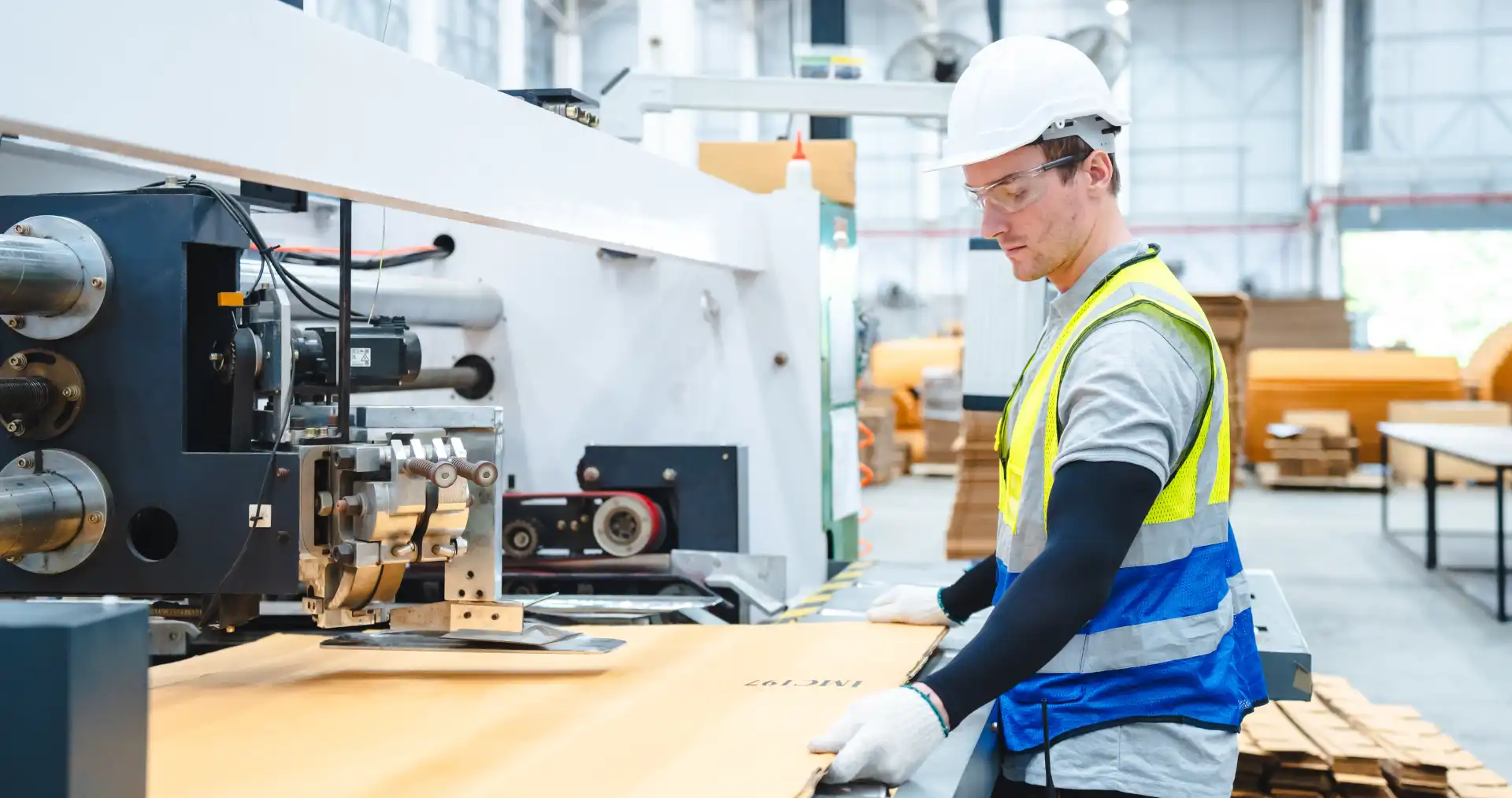


A complete ERP
for manufacturers of paper, packaging,
films and laminates
From raw material, through the production floor, logistics and quality control, to finance, HR and BI analytics, Asseco ERP covers the full operational cycle of a paper and packaging plant. Implemented in Polish plants for more than 25 years.
One system for many paper and board production profiles
Asseco ERP is not a solution tailored to one type of plant. Implementations in plants with different production profiles have given us knowledge that makes our solution more precise than any general-purpose system.
Four characteristics of this industry that need dedicated solutions, and that Asseco ERP can handle
Which paper and packaging production challenges does Asseco ERP solve??
Six steps in one system
with no data re-entry
Every stage uses the same technological data. Sales, production, warehouse, transport and finance work on one model, and information does not circulate in emails or spreadsheets.
Inquiry and quote
The customer sends a specification or a sample. The technology department creates a routing sheet that breaks the product down into operations, machines and materials. On this basis, the sales department calculates the price, which depends on the run length, grammage and number of operations.
Order and technology
After the quote is accepted, a production order is created and linked to the sales order. The technology of the package or product goes to the production plan automatically, with no re-typing.
Planning and scheduling
The APS module schedules orders on machines backwards from the delivery date, taking into account printing, die-cutting, gluing or roll converting times. The schedule is always up to date, because it is generated from the actual status of orders.
Raw material preparation
The warehouse selects parent rolls with the FIFO algorithm and issues materials for the order. The ink or glue mixing room prepares recipes, and the tooling department prepares plates, printing forms or cutting dies. Everything is assigned to the order.
Production and quality control
Operators confirm execution with e-Kiosk terminals on the production floor. Machines return data on quantities and operation times. Quality control and non-conformity reports are registered on an ongoing basis, and defects are classified and analyzed per product.
Warehouse, shipping and settlement
Finished products are received into the warehouse with barcode scanning. Transport is planned and documented in the system. The invoice is generated automatically, and controlling calculates the actual manufacturing cost and margin before the month-end close, not after it.
Full functional coverage
from the production floor to the HR department
Asseco ERP is one integrated system, not a set of applications. All modules use a common data model, so a change in the warehouse is immediately visible in finance and planning.
Every decision-maker has their own questions, and Asseco ERP has the answers
An ERP implementation decision involves several departments at the same time. Below are the key expectations of each role, and the specific Asseco ERP features that meet them.
“Is the company profitable? Which products and customers make money, and which generate losses?”
BI dashboards with profitability per product, customer and contract. Controlling with current order costs without waiting for the month-end close. One view of the whole company, without consolidating data from several systems.
“How much does each order really cost? When will the month-end close be?”
TKW and CKW per order calculated during production. A complete Finance and Accounting module integrated with production, with automatic posting. JPK_V7, KSeF, support for capital groups. Month-end close without reconciliation with the warehouse.
“When will the order be ready? Where does production stand, and where are the bottlenecks?”
APS with an up-to-date schedule on the machines. Integration with the machinery: the status of every order in real time. You see delays before they happen, not after.
“Which raw material goes into which order? What is the real cost of waste and scrap?”
The FIFO roll selection algorithm and e-Kiosk on the production floor to confirm picks and operations. Non-conformity reports and defect analysis per operation. Controlling shows the effect of scrap and reprints on the order cost.
“Where are our rolls? What do we have in stock and when should we bring in new raw materials?”
WMS with full traceability of every roll: length, grammage, location, link to the order. Mobile terminals for receipts and issues. Transport planning for your own fleet and integration with couriers. Automatic purchase order proposals based on production plans.
“Do the shift schedules comply with the Labor Code? How much does an hour of work on each machine cost us?”
The PRC module registers working time on machines and settles shifts and overtime in line with the Polish Labor Code. HR and payroll fully integrated with Finance and Accounting: the payroll goes straight into costs. HR Portal for employees. Workforce planning for shift production.
“Plan versus actual deviations: where, why and by how much? Which cost center generates losses?”
The CTR module with deviation analysis per order, product and cost center. Current costs without waiting for reposting. Budgeting of production costs with scenario simulation. The data feeds BI without manual reporting.
The experience of Asseco Business Solutions
in the paper and packaging industry means many years
of implementations in Polish production plants
We understand the specifics of shift production, a wide product range and the need to implement without disrupting production.
Asseco ERP grows with your company, not the other way around.
An ERP system in the paper and packaging industry is not a tool for accounting. It is the backbone of the whole manufacturing process. The key was to move the material list and technology into one system, in which the planner, warehouse worker, machine operator and cost controller work on the same data. The value of Asseco ERP is flexibility: the system adapts to the plant’s processes, not the plant to the system.

 Wapro ERP