
Asseco Merit ERP · Process-driven ERP system with AI Process first, intelligence second
ERP system for medium-sized and large manufacturing, trading and service companies in which one case (an order, an invoice, a work order) passes through several departments.
Asseco Merit ERP has 550+ ready-made processes. Dozens of AI agents and assistants work in them. You measure the time of the whole case and you see the effect of AI in numbers.
The task became a hundred times faster, the case only 3% faster. See whyCompanies that chose Asseco Merit ERP





















What is Asseco
Merit ERP?
Asseco Merit ERP is a process-driven ERP system for medium-sized and large manufacturing, processing, trading and service companies. The system is developed by Asseco Business Solutions S.A. Asseco Merit ERP takes each case through the departments according to a defined process: from the customer order, through production and the warehouse, to the invoice and the accounting entry. When one person completes a step, the system passes the case to the next person and sets a deadline. As a result, you can see who has the case and at which stage it is.
Asseco Merit ERP covers production, logistics and sales, finance and accounting, HR and payroll, and controlling. It can also work as a standalone HR and payroll system. Asseco Merit ERP supports multi-company operation, so several companies of one capital group can work on one installation.
See the modulesAI agents in the process
Asseco Merit ERP has 550+ ready-made processes as standard. AI agents and assistants work in them, within the roles and permissions of the users. An employee approves each result of the AI work.
Example: an order from an e-mail in Asseco Merit ERP
- ProcessThe customer sends an order by e-mail.
- AI agentCreates a draft order from the e-mail text: material codes and quantities.
- Sales representativeChecks and approves or corrects the order prepared by AI.
The process sets the route, AI makes it shorter.
The task became a hundred times faster, the case only 3% faster
In Asseco Merit ERP, the effect of AI is measured by the time of the whole case, not by the time of one task. Example: an AI agent reads an invoice in a few seconds. But for most of the time the case waits: for approval, for goods, for the correct record in the system. That is why Asseco Merit ERP first measures the time of the whole case, then puts the process in order, and only then enables AI agents where they shorten the time.
Reading and describing a purchase invoice
Task agent: one step, one task
AI recognises invoice data from KSeF (the Polish National e-Invoicing System) or from a scan and suggests the cost centre, the account and the approvers.
Purchasing cycle: from requisition to payment
The same case after the task agent is enabled
The invoice still waits 6 days for approval and the goods wait 6 days for receipt. The agent does not work there.
Illustrative example. A measurement shows the real times in your company.
When you choose an ERP with AI, ask:
what does the AI work on and how will you measure its effect?
A task agent speeds up one step. AI in the process improves the whole case
The case waits where AI does not work. You see the effect of AI only when you measure the time of the whole case, not of one task. Asseco Merit ERP makes this measurement from the first day, because each case has a recorded route.
| Criterion | AI in the process · Asseco Merit ERP | Task agent |
|---|---|---|
| The customer’s question | What does the AI work on and how will you measure the effect? | How many AI agents does the system have? |
| What the AI sees | The whole case: stage, role, history and time plan | One document or one list |
| Measure of the effect | Time of the whole process, before and after the change | Minutes in one task |
| Durability | You cannot add company processes in a month. Asseco Merit ERP has 550+ of them as standard | An AI function can be added in a few weeks |
Asseco Merit ERP for medium-sized and large companies
ERP system for production, logistics and sales, finance, HR and payroll, and controlling.

Keep the books, look after your finances, analyse and find directions for growth.
- Automatic calculations
- Clear financial and accounting data
- JPK (SAF-T) files, e-financial statements and integration with KSeF
- Financial and management analyses

Increase efficiency and automate employee service processes.
- Automatic HR and payroll processes
- Electronic document workflow
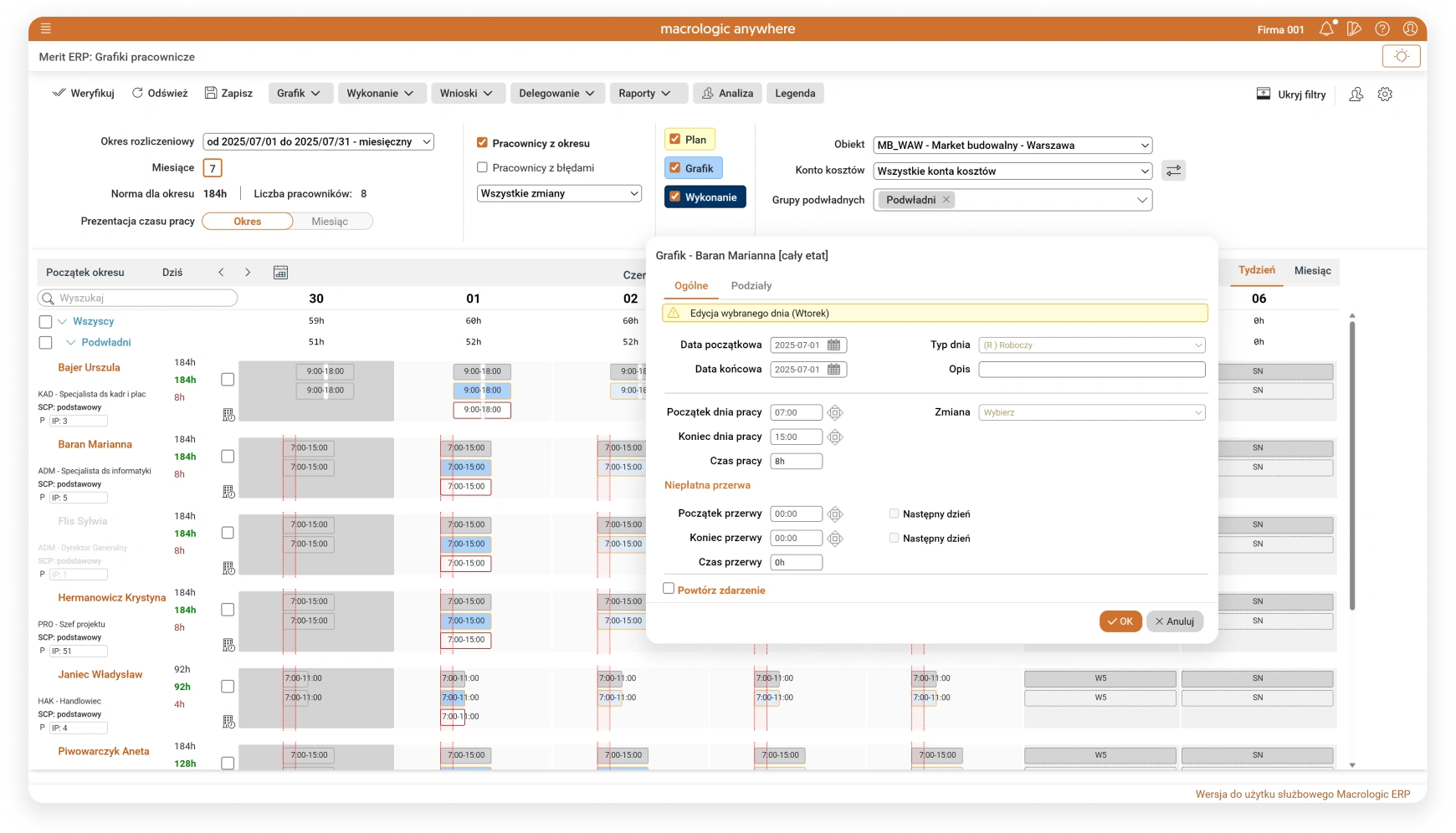
- Working time settlement and management
- Employees check their pay and leave balance and submit requests in Asseco Portal HR, also in the Asseco ERP Portal mobile app

Manage sales and the warehouse. Plan, control and settle. Work with business partners, analyse data and report results.
- Handling of all orders from customers and to suppliers
- Handling of high-bay warehouses and pallet warehouses
- Control of receivables and payables

Manage production from planning, through manufacturing, to settlement and reporting for the management board.
- Simulations and analyses of production data
- Organisation of production and stock levels
- Full documentation of production and department stock

Control the budget and plan the future of the company. Turn data into knowledge.
- Controlling models
- Budgeting
- Data processing
- Margin analysis IV

Analyse company results from many angles and make the best decisions.
- Information about high-margin products and customers
- Planning, ongoing changes to activities and forecasting of company results
- Identification of unprofitable business relationships
Process orientation · What is a process-driven ERP? A process-driven ERP system that guides the work of your company
Each case in Asseco Merit ERP (an invoice, an order, a request or a work order) has a recorded route: who does what, in which sequence and in what time. A BPMN diagram describes the route and the system executes it. Asseco Merit ERP assigns tasks, watches deadlines, measures time and does some of the steps itself.
See how processes put daily work in order
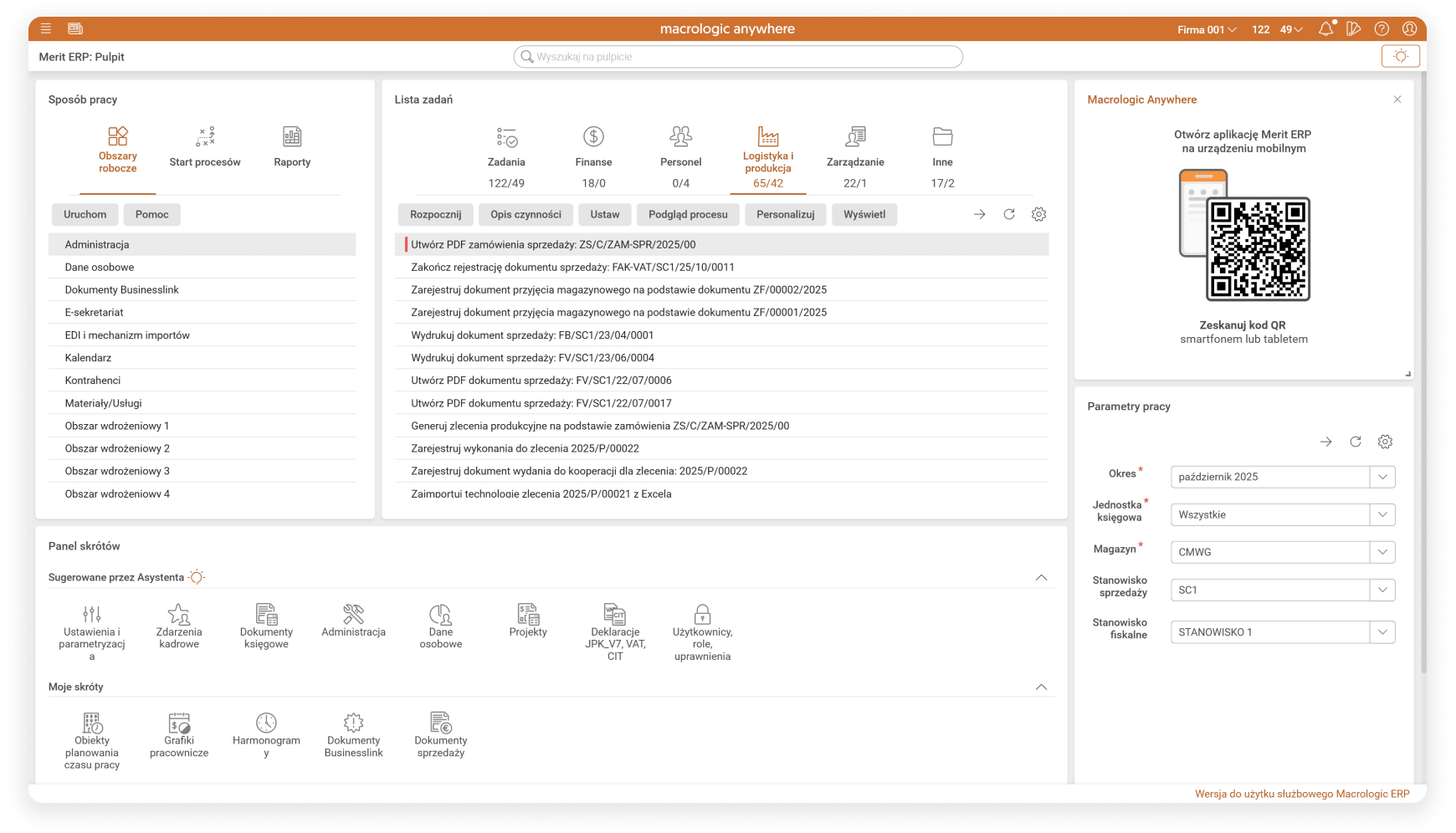
Tasks on the employee’s list
Each employee sees their tasks with a priority and a deadline. The list refreshes at the moment a new task is created.
Permissions that come from roles
An activity on the diagram belongs to a lane, and the lane corresponds to a role. You change the lane of the activity and one change updates the scope of access.
Case status in one place
On the document you see the diagram with the current stage, the history of activities and the person who owns the task.
Steps done automatically
Account coding, archiving, updates of reservations, deadline notifications and creation of work orders run cyclically, also at night.
Fast changes in the organisation
You move an activity in the process modeller. The new approval path works from the next document.
Measurable effect
You compare planned time with actual time: for the whole process, for one activity and for each run.
What your company gains
Growth with the same team
Cases pass between departments by themselves, so the team does not lose time handing them over. The growth of the company is based on a better-arranged workflow.
A wider offer for customers
A short and predictable route from enquiry to delivery lets you offer shorter lead times, smaller batches and more variants.
Three ways to a shorter cycle: process enabled, process adjusted, AI agent
In Asseco Merit ERP the cycle gets shorter in three ways: by enabling a process, by adjusting a process and by AI agents. In the examples below, the largest gain came from enabling a process where it was missing and from adjusting the process to the way the company works. AI agents added the rest in steps that were already in order.
Measure, improve, repeat. You decide, we implement and measure
- 01
Merit measures
Asseco Merit ERP shows how the company works: the time of each stage and the work outside the process. The measurement works from the start.
- 02
The consultant shows
An Asseco consultant analyses this data with Asseco tools and shows what is worth discussing. The tools stay with Asseco: you do not buy them, you do not need to learn them, and you get the conclusions.
- 03
You decide
Nothing changes without your decision.
- 04
We enable and measure
The consultant enables the changes. After the change, the dashboard measures the effect with the same indicator.
Check it on an example: select a cycle and go through the stages
An Asseco consultant showed each change, the customer approved it, and the dashboard measured its effect. The “AI agent only” switch shows a scenario in which the company adds a task agent, that is AI that speeds up one task and does not change the process.
- O2C
- Sales (order to cash): from the customer order to the receipt of money
- P2P
- Purchasing (procure to pay): from the requisition to the payment to the supplier
- H2R
- HR (hire to retire): in the example, from the hiring decision to the moment the new employee is ready to work
What the measurement showed
AI in the process · How is it different from a chat? Artificial intelligence that works inside the process
Unlike a chat, AI in Asseco Merit ERP works as a process step: it knows the user’s role, the stage of the case and the permissions. AI in Asseco Merit ERP is based on language models and knows the user’s role, the stage of the case and its permissions. That is why AI in Asseco Merit ERP answers questions, does tasks and works as a process step.
Question
Personal assistant, application support, company information and data analysis. Ask in natural language about settlements, debtors, documents in KSeF, bank transfers or fixed assets.
Action
AI does a task in the system: it creates a work order, opens a maintenance request, approves leave, prepares a medical examination referral. Before it saves, it shows a summary and waits for confirmation.
Activity in the process
AI as a step on the diagram, next to manual and service activities. You define the context of the query, the format of the answer and how the result is processed. A person approves the decision.
- 01Context
The process gives the AI the role, the stage of the case and the permissions
- 02Preparation
AI prepares the result where the work takes place
- 03Decision
A person approves the decision
- 04Trace in the system
The history stays in the process and the case moves on
AI agents and assistants · What works today? Dozens of AI agents and assistants work in Asseco Merit ERP today
AI agents do tasks in the process and a person approves the result. AI assistants answer and carry out commands after confirmation.
See all AI functions in Asseco ERPFinance and accounting
- Invoice reading without templates
- Selection of approvers
- Cost allocation to cost centres
- Readiness to close the period
Sales and customer service
- Order from an e-mail
- Sorting of correspondence
- Complaints from an e-mail report
- Product descriptions
HR and payroll
- Approval of leave and electronic sick notes (e-ZLA)
- Medical examination referrals
- People to register with ZUS, the Polish social insurance institution (ZUA form)
Production
- Work order proposed from history
- Planner’s assistant
Security · Who decides? A person decides, AI is accountable
AI prepares and proposes. A person makes the decision. Each AI proposal in Asseco Merit ERP waits for approval by a person who has the permission to give it. The same applies to changes in processes: the consultant shows, the customer decides.
AI within roles and permissions. You decide which steps the system does and which steps a person does
Access in line with the role
AI sees only the data that the user has permission to see. AI actions are available only to authorised persons.
Summary before saving
For an operation that saves data, the assistant shows a summary and waits for confirmation.
Event log
The system records each AI decision: who, when and what. AI assistants keep an event log.
Data not used to train models
Data given to the assistants is not used to train models.
The step belongs to the process
The AI activity is on the diagram next to the activities of people. The model indicates the operation and the data, and the process executes it with its roles and approvals.
An area, not a person
The agent indicates an area and a direction to look at, not a specific person or case. The analyses of the process dashboard contain no names and no logins.
Processes in departments · What will my department gain? Processes that support every department of your company
In each department, Asseco Merit ERP handles cases according to processes, and the process dashboard shows the time and the effect of changes. Select an area and check what you gain from processes, AI agents and the process dashboard in Asseco Merit ERP. The dashboard examples are the same cycles that we show above.
Get a current picture of the company’s processes and make decisions on shared data.
- Process performance analysis: average time and median of each process and the longest steps on a chart
- One set of data for the warehouse, finance and controlling
- Process dashboard divided into cycles: sales (from order to cash), purchasing (from requisition to payment) and hiring (from the hiring decision to readiness to work): time of the whole case and work outside the process, without names
- The BI assistant answers questions asked in plain language, based on analyses in the Qlik cloud, with a link to the source report
- The answer shows the data area and the filters on which the conclusion is based
- IMeasurement
Time of sales, purchasing and hiring calculated from documents in the system, with no manual data collection.
- IIProcesses enabled
Cases from outside the system get a recorded route. In the purchasing example, work in the process grows from 62% to 78% of events.
- IIIProcesses adjusted
An Asseco consultant shows where the case waits. The management board and the managers select the scope for the quarter.
- IVAI agents
Report after the quarter: how much shorter the cycle is, how much the processes gave and how much the AI agents gave.
In the example: sales 52 → 44 days, purchasing 34 → 25 days, hiring 10.5 → 6.9 days. An Asseco consultant showed it, the customer decided, the dashboard measured it. Demonstration data.
Close the period efficiently: documents go through the workflow, approval and account coding by themselves.
- Invoice workflow with multi-level approval, also with a majority decision of the approvers (quorum)
- Automatic account coding of invoices, warehouse documents and payrolls
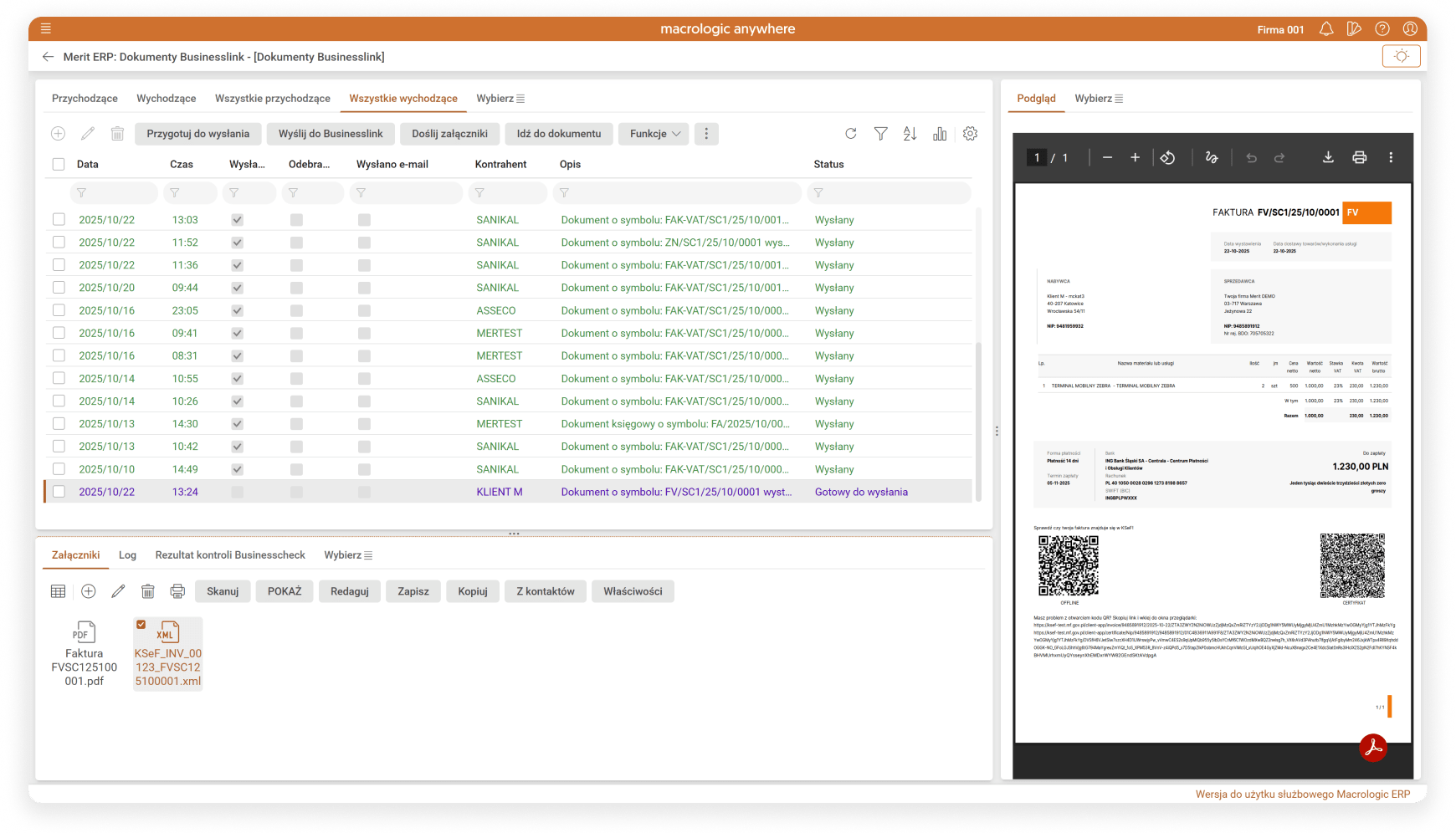
- Integration with KSeF with a Businesscheck control on the specific document
- Suggestions for invoices from Businesslink: workflow process, cost allocation, approvers and account
- The assistant checks whether logistics documents, invoices in the workflow, payrolls, depreciation and cash reports have been coded
- IMeasurement
An invoice waits 6 days on average for description and approval. 14% of invoices are outside the workflow.
- IIProcesses enabled
Each invoice from KSeF goes into the workflow, including costs from outside the purchasing department.
- IIIProcesses adjusted
A substitute in the approval step and a 2-day standard for the decision. The invoice is linked to the goods receipt.
- IVAI agents
AI reads the invoice without a template and selects the workflow process, the cost centre and the approvers. A person approves.
In the example, the purchasing cycle gets shorter from 34 to 25 days (−25%). An Asseco consultant showed it, the customer decided, the dashboard measured it. Demonstration data.
Handle employee matters in processes: from a leave request to the control of periodic medical examinations.
- Ready-made HR and payroll processes: HR administration, payroll, working time, Asseco Portal HR and documentation
- Requests from Asseco Portal HR come back with a decision, and the system reminds you about requests waiting for approval
- Cyclical checks of contracts, medical examinations and certificates that are about to expire
- Approval of leave and of an electronic sick note (e-ZLA) with a command given to the assistant
- Medical examination referral and a list of periodic examinations that are about to expire
- IMeasurement
A new employee waits 3 days on average for access to the systems. The medical examination referral is created only after the contract is signed.
- IIProcesses enabled
One onboarding process for HR, IT and administration, together with equipment and access rights.
- IIIProcesses adjusted
The medical examination referral is created immediately after the request is approved, in parallel with the contract.
- IVAI agents
The AI assistant indicates the people to register with ZUS (ZUA form) and issues medical examination referrals in bulk.
In the example, the hiring cycle gets shorter from 10.5 to 6.9 days (−34%). An Asseco consultant showed it, the customer decided, the dashboard measured it. Demonstration data.
Plan, carry out and settle production in one process: from the work order to the report.
- The work order is created automatically from a sales order, a plan or stock levels
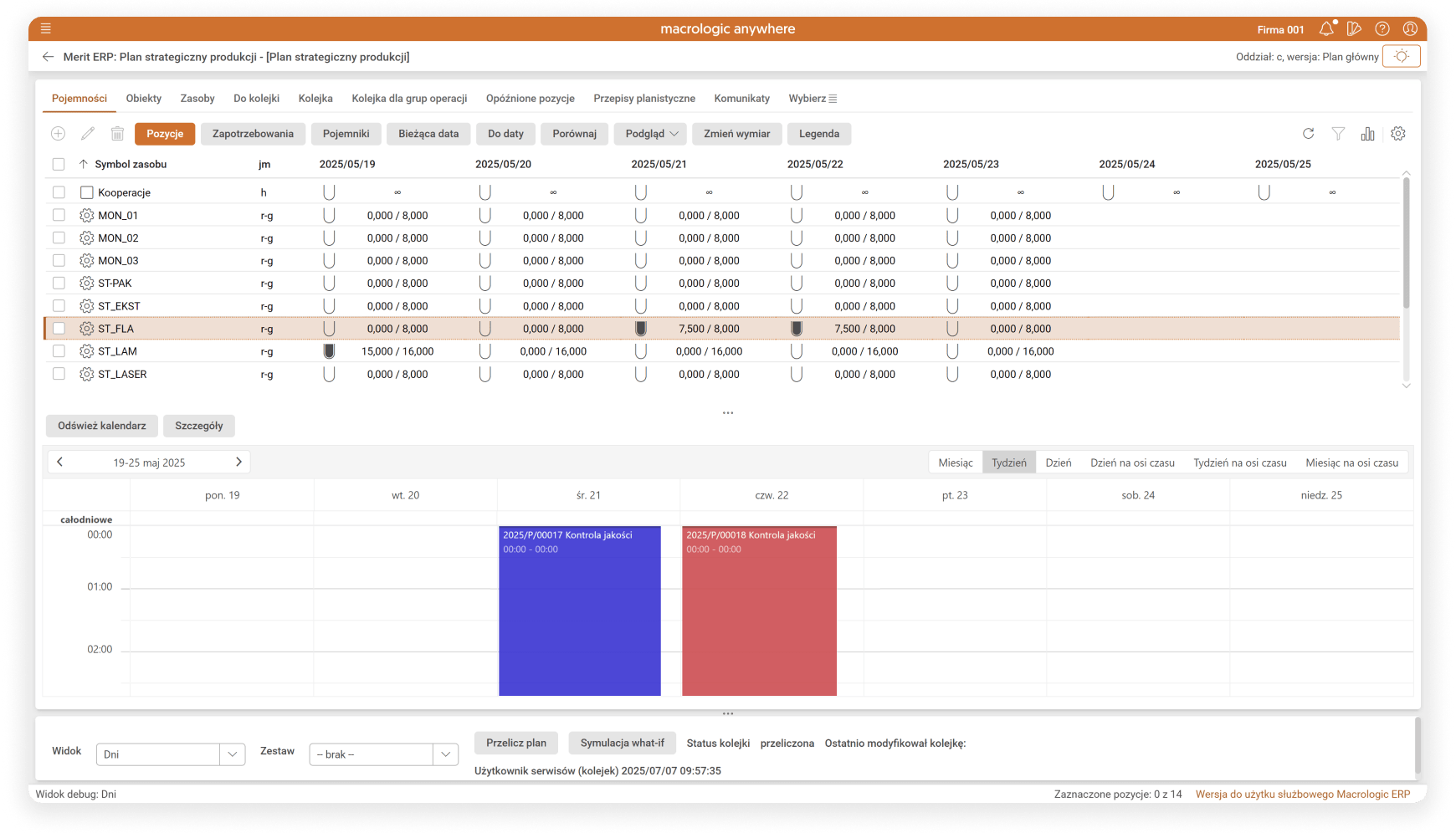
- Strategic plan with resource capacity and updates of operation dates
- Subcontracting and settlement of raw materials in the same process
- A simple production or workshop order created in a conversation: the product and the quantity are sufficient
- A maintenance request straight from the shop floor, by text or by voice
- IMeasurement
The dashboard shows how long the work order waits between the plan and the start of the operation, and where it waits for material.
- IIProcesses enabled
The material order is created already when the work order is planned.
- IIIProcesses adjusted
A maintenance request from the shop floor goes directly to maintenance, with a deadline.
- IVAI agents
AI proposes a work order from the production history, the planner approves it.
A measurement after the change will show how much the change shortens the cycle in your company. An Asseco consultant showed it, the customer decided, the dashboard measured it. Demonstration data.
Handle orders from acceptance to delivery in one predictable process.
- Sales order with workflow and fulfilment, reservations updated cyclically
- An invoice with a reservation in the warehouse starts a process that generates the goods issue
- Transport with shipping instructions, pick-up sequence and the CMR document
- A draft order from the text of the customer’s e-mail: material codes and quantities
- An offer in the business partner’s language, prepared by an AI activity from a sales opportunity
- IMeasurement
Reservation → goods issue takes 4.8 days against a standard of 2 days. 32 invoices were created without an order.
- IIProcesses enabled
Invoices only from an order, and a debt collection process with a reminder from the first day after the due date.
- IIIProcesses adjusted
A 2-day standard for reservations, and an invoice with a reservation immediately starts the goods issue.
- IVAI agents
An AI agent creates the order from an e-mail, the sales representative approves it.
In the example, the sales cycle gets shorter from 52 to 44 days (−15%). An Asseco consultant showed it, the customer decided, the dashboard measured it. Demonstration data.
Develop workflows and permissions in the process modeller, in one consistent system.
- Permissions come from lanes: an activity on the lane of a role is available to that role
- A change of the approval path in the modeller works from the next document
- Service processes do technical steps cyclically, without the user
- A workflow for an invoice, a request or a business trip built in a conversation with the assistant
- Event log of AI assistants: who approved what and when
- IMeasurement
The dashboard shows work outside the process: cases that go by e-mail or in a spreadsheet.
- IIProcesses enabled
You add the missing process in the modeller. Permissions come from lanes.
- IIIProcesses adjusted
A change of the approval path works from the next document.
- IVAI agents
The assistant builds the workflow in a conversation. The AI event log shows who approved what and when.
The dashboard measures each change with the same indicator. An Asseco consultant showed it, the customer decided, the dashboard measured it. Demonstration data.
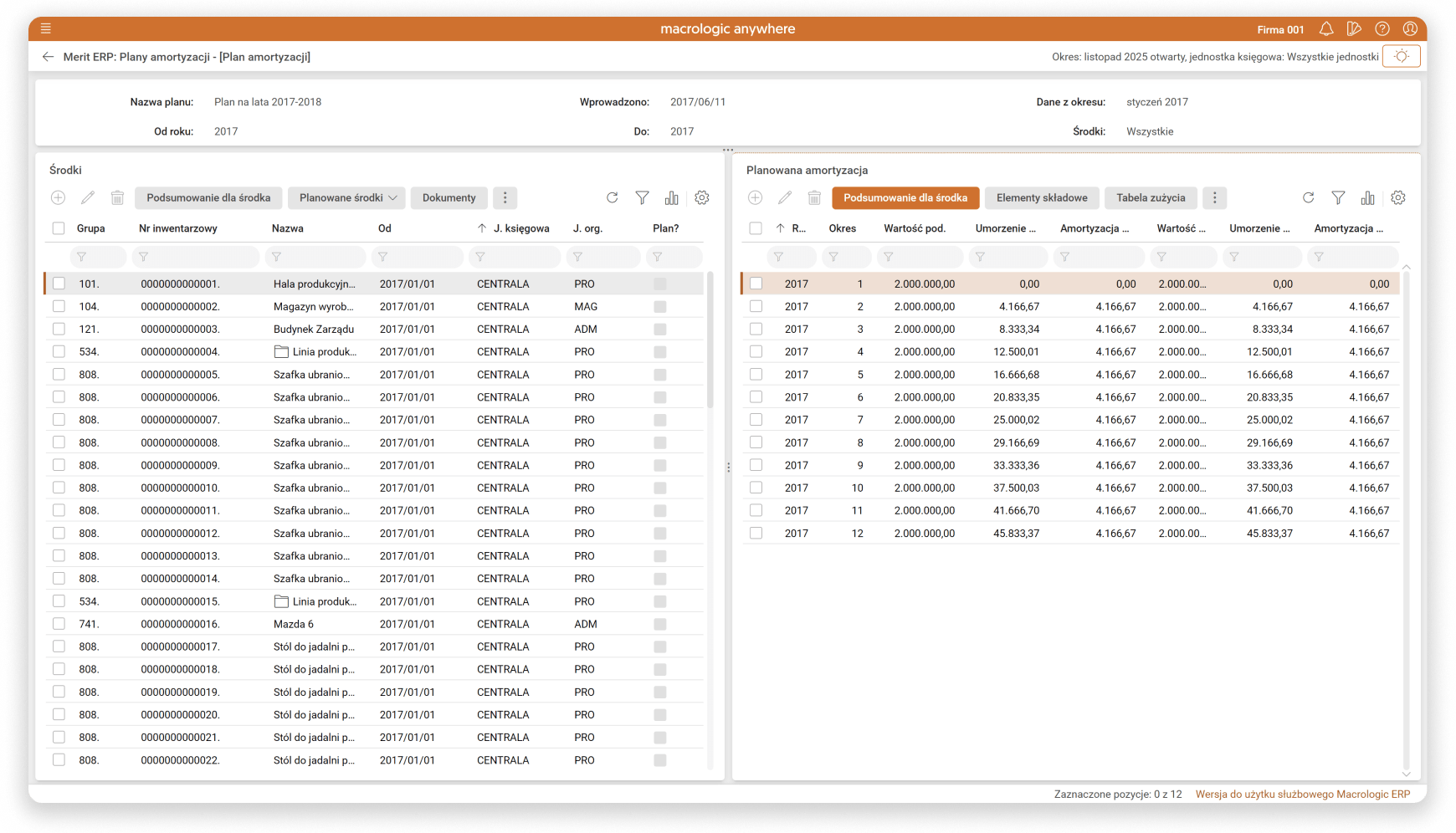
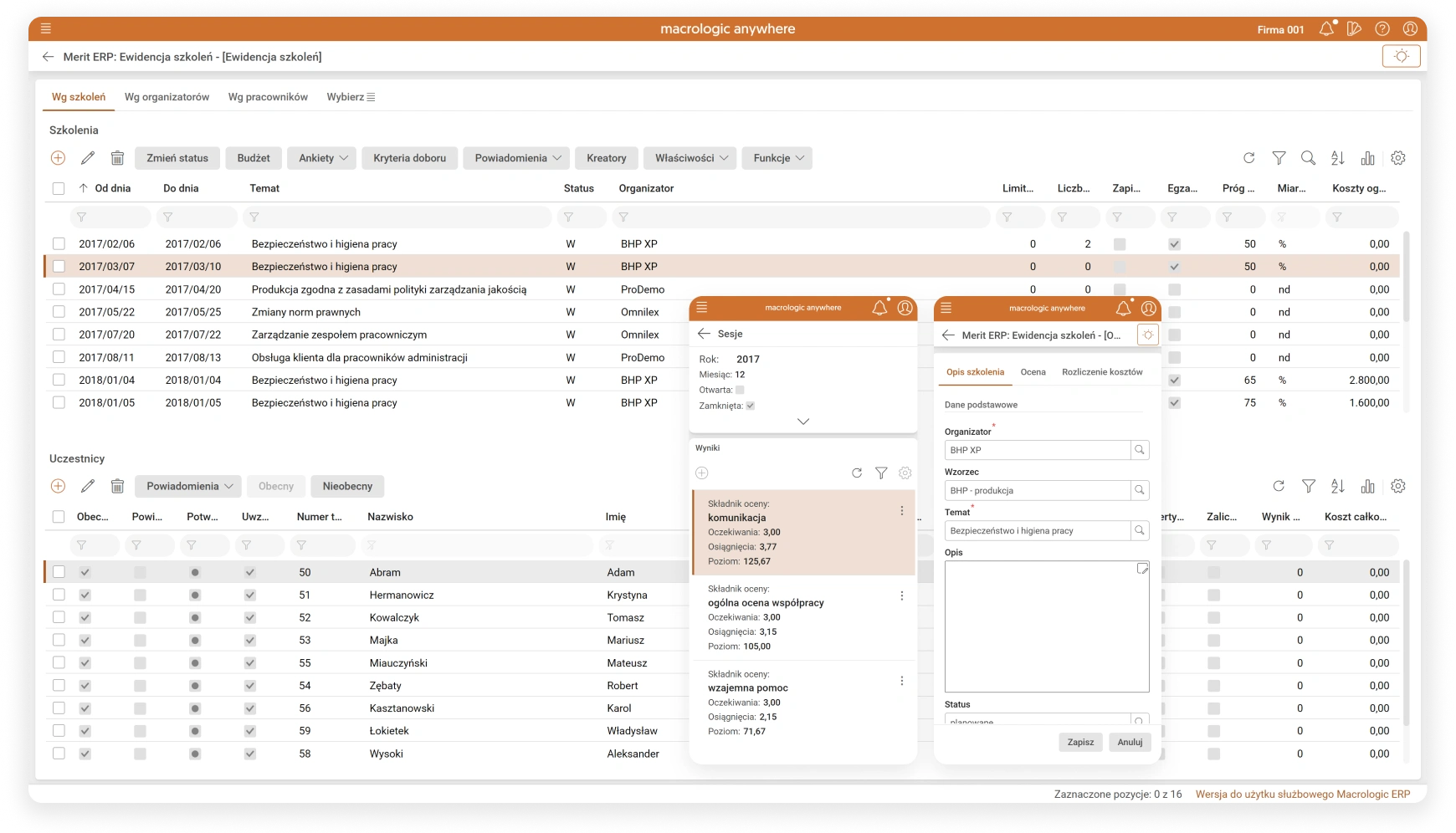
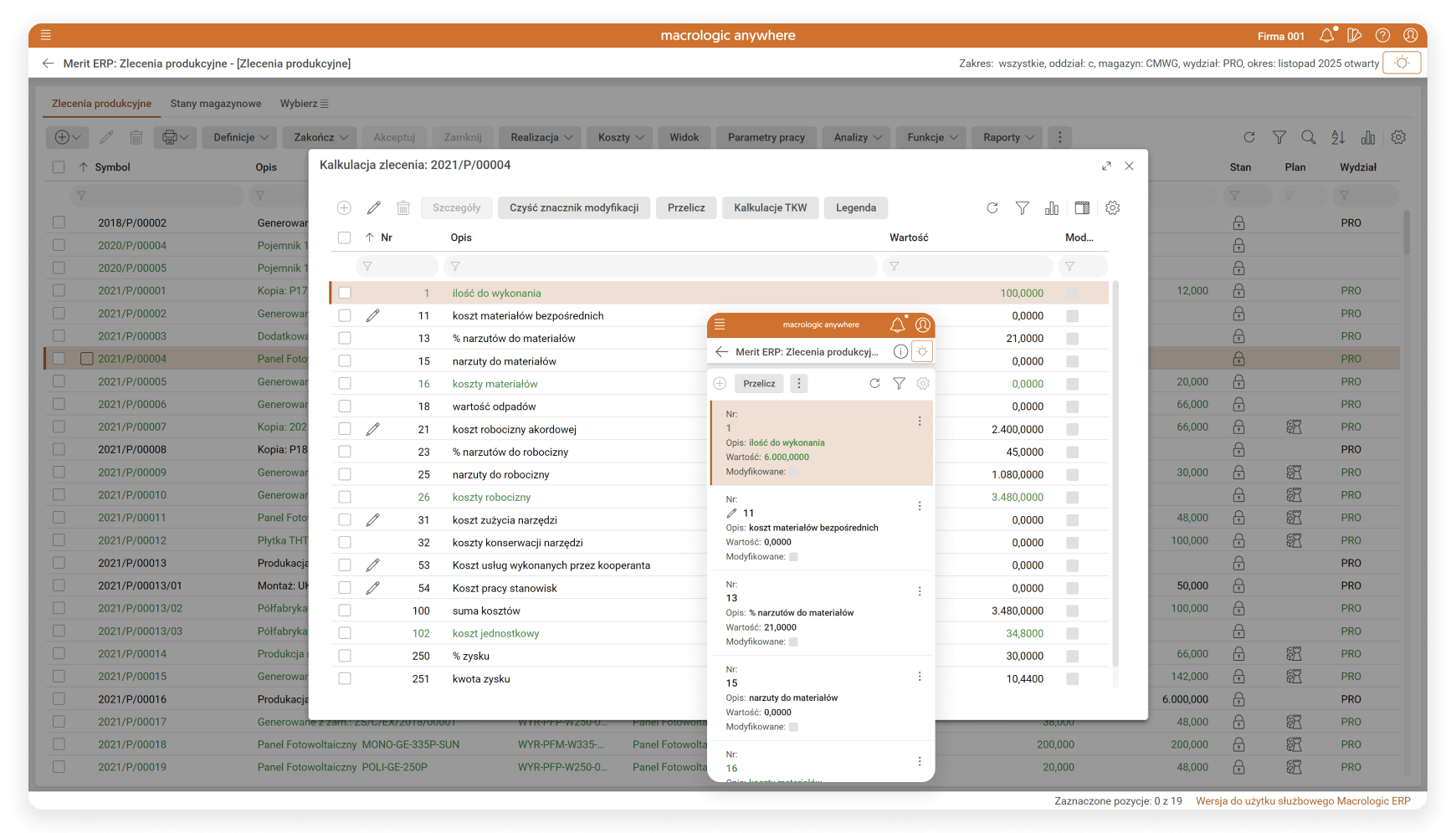
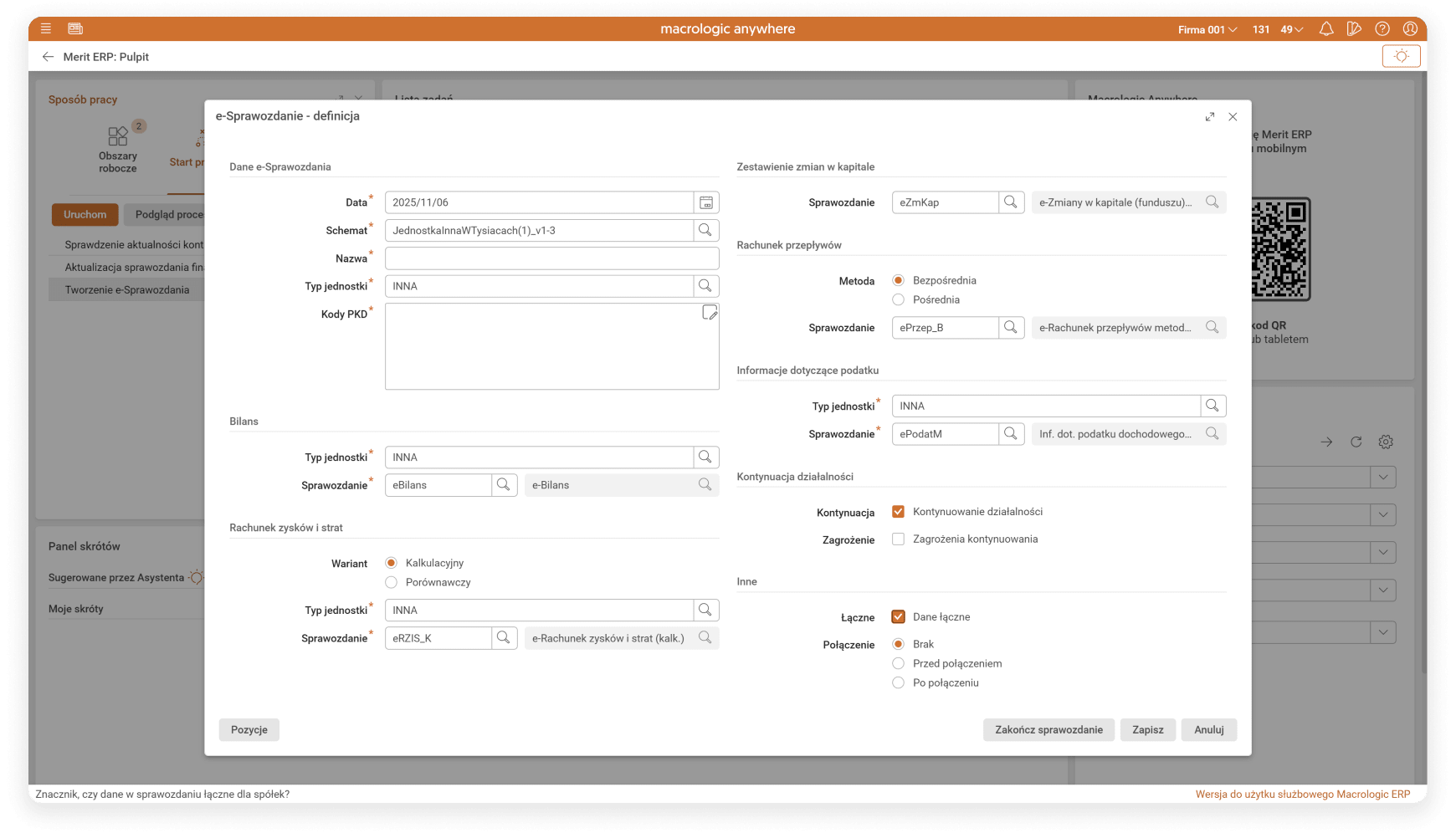
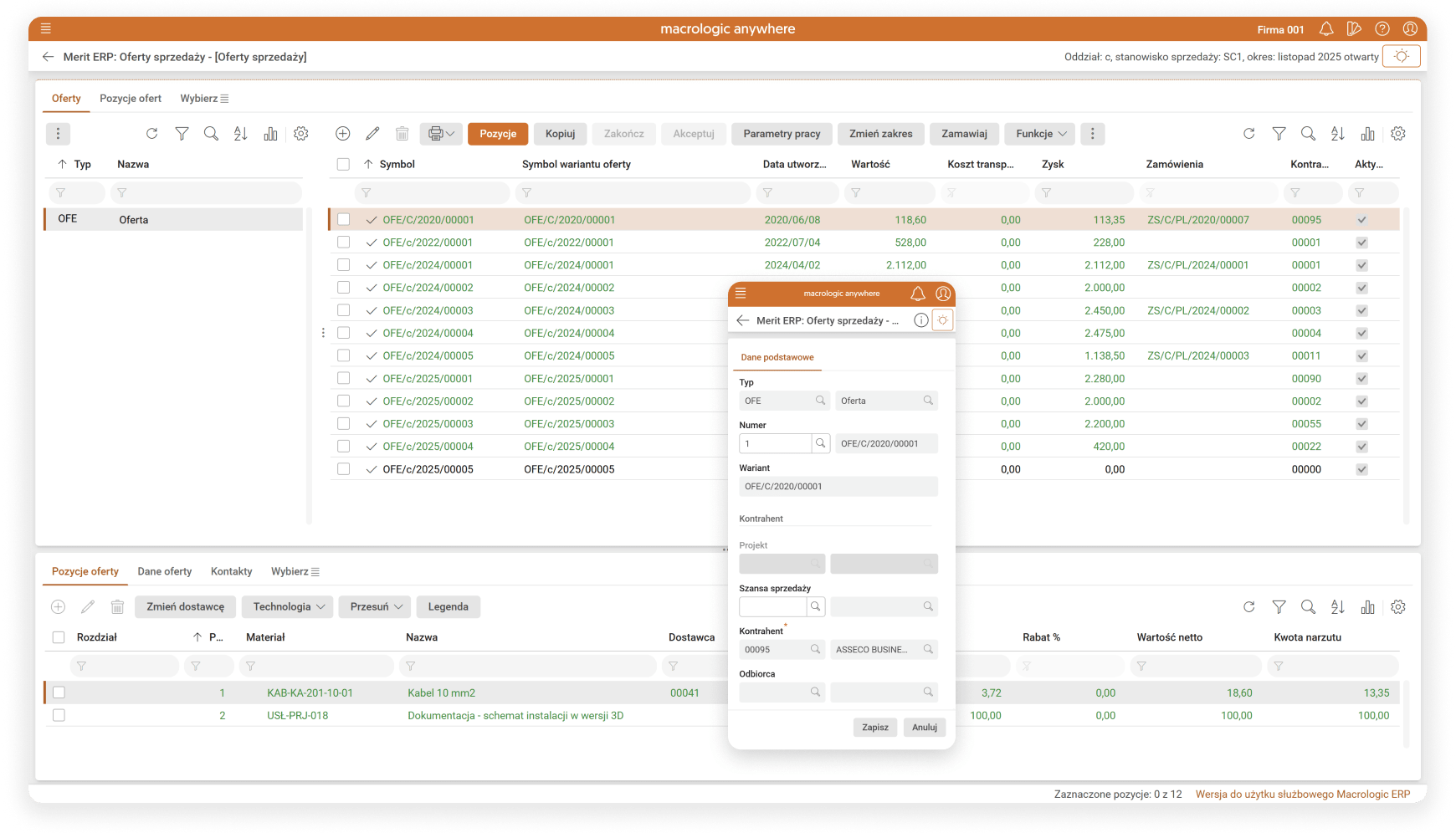
Intuitive interface This is what work in the Asseco Merit ERP modules looks like
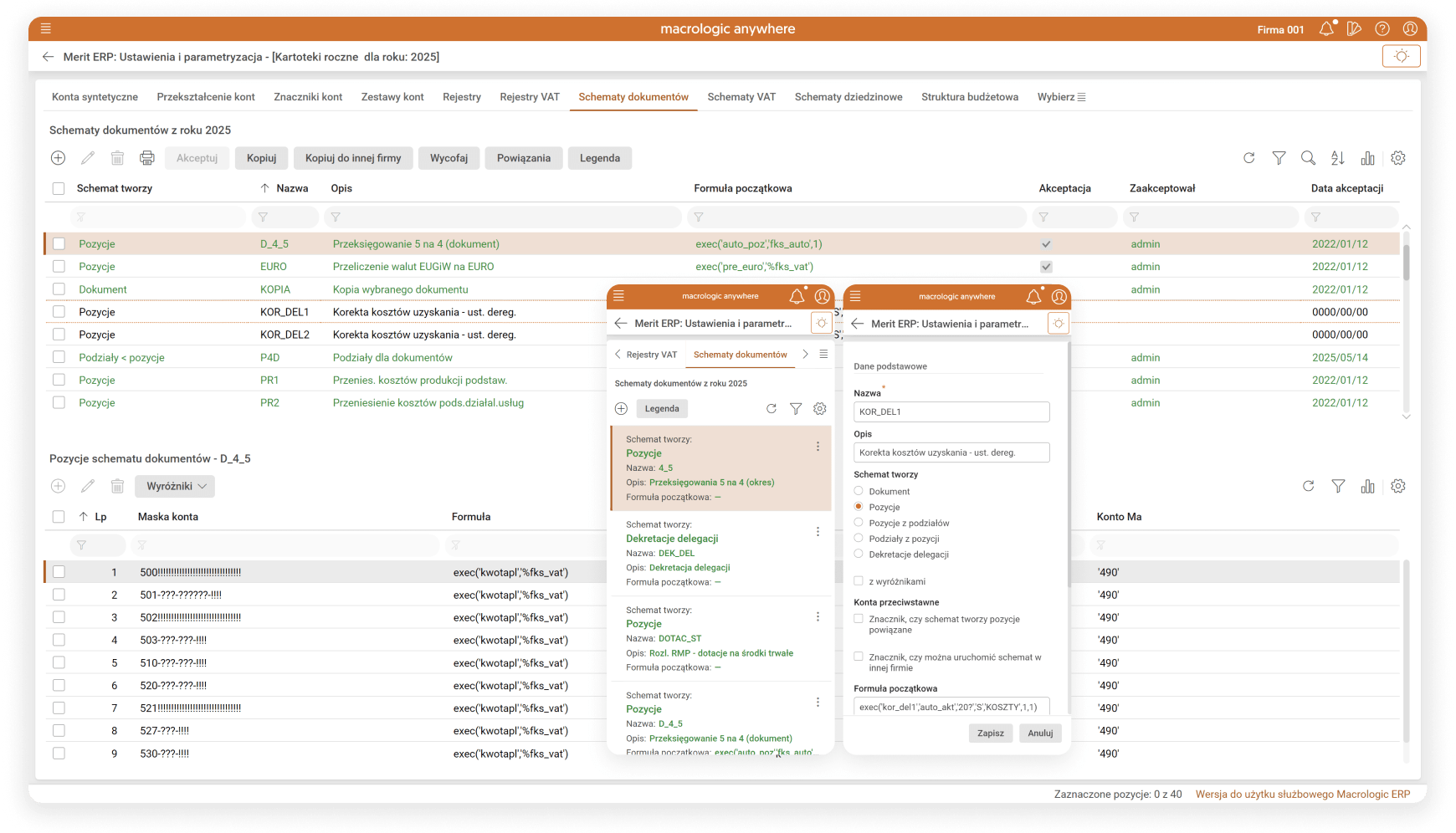
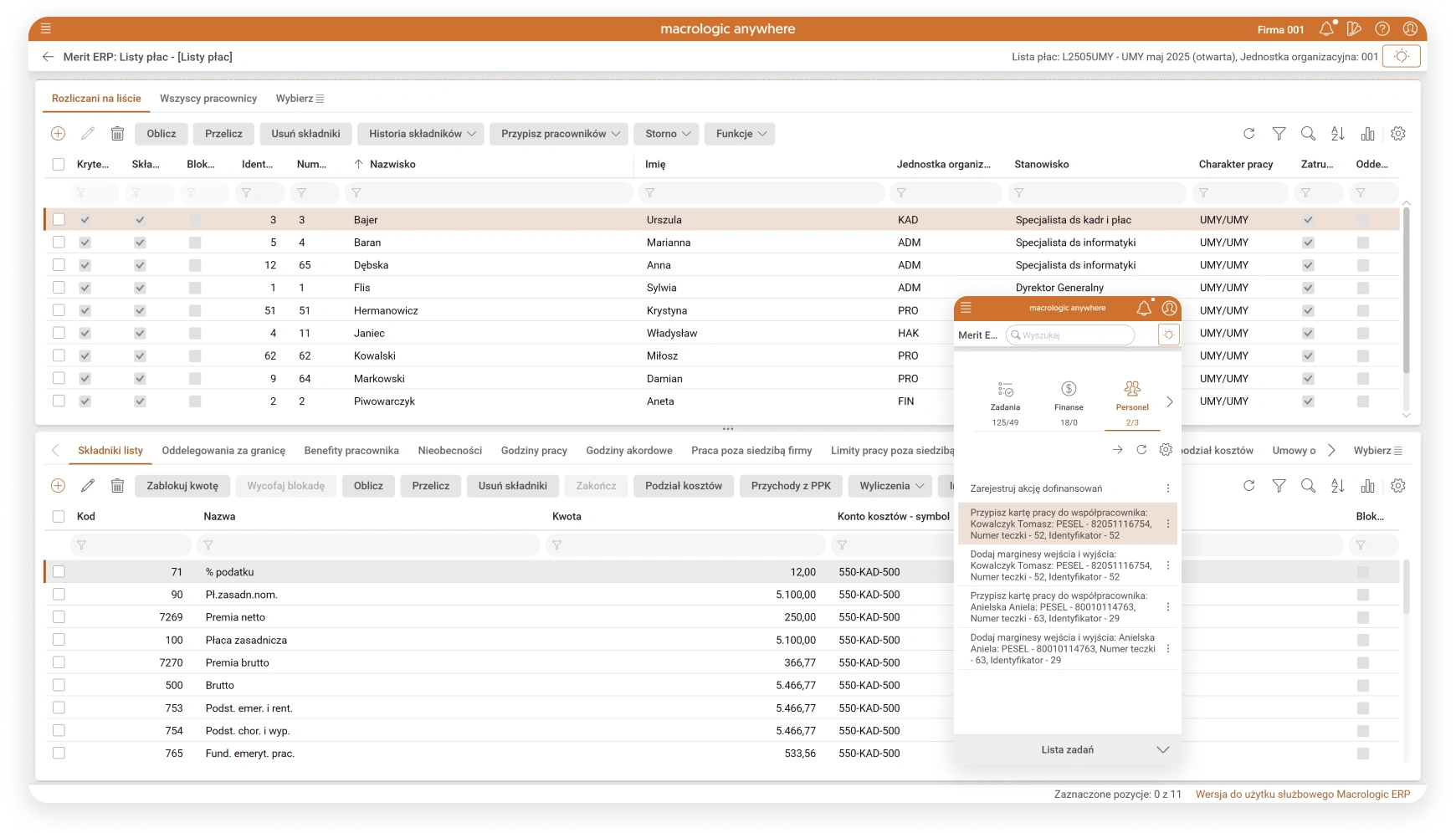
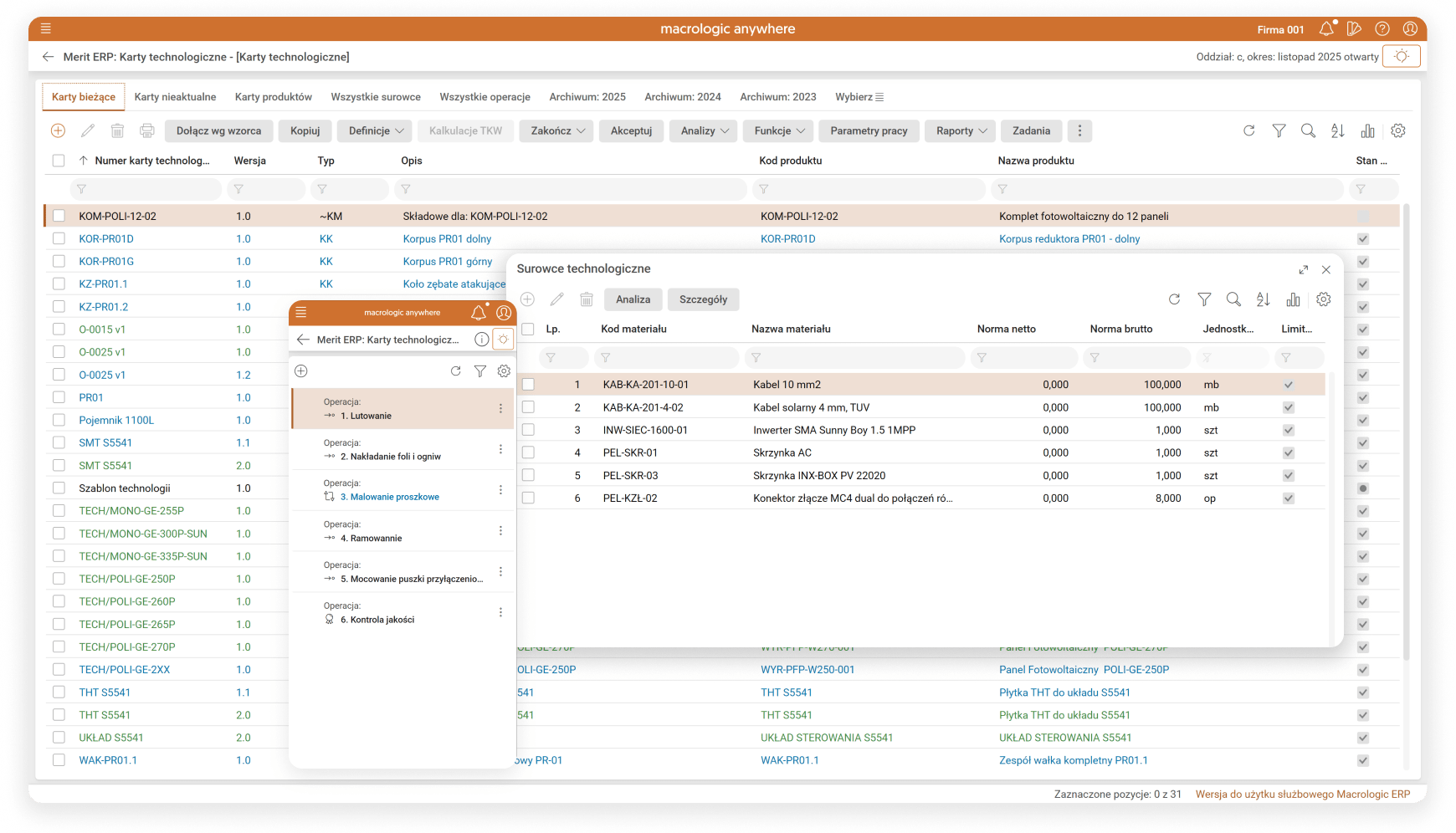
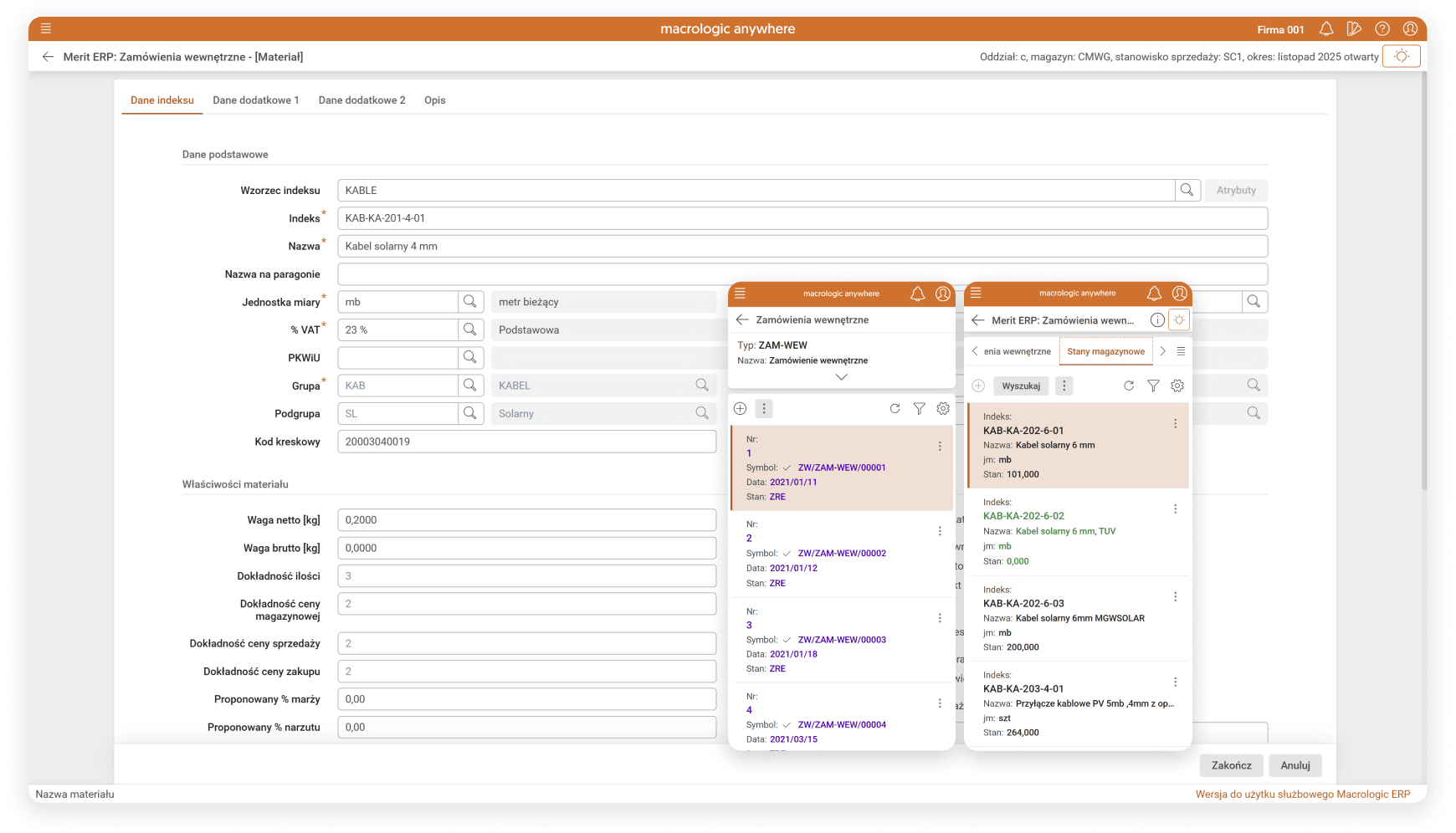
Even more possibilities: Business Cloud services
Extend your Asseco Merit ERP system with the additional possibilities of Business Cloud!
Talk about the solution- Asseco Portal HREmployee self-service: requests, documents, personal data and certificates.
- BusinesslinkExchange of documents with the company’s business environment, including e-invoices and confirmations.
- BusinessbankTransfers, statements and account balances without leaving the system.
- SEODElectronic document workflow for cases that go beyond the ERP.
- Electronic signatureApproval and signing of a document in one step.
- Business analyticsReports and visualisations on the system’s operational data.
- RODO UtilityHandling of personal data requests and data retention (GDPR) as a process.
What else can you handle in Asseco Merit ERP
From a KSeF invoice that links itself to the delivery notice, to the work schedule and the warehouse: see what else Asseco Merit ERP puts in order in your company.





How does Asseco Merit ERP work in practice?
Cyfrowy Merit (Digital Merit) is a series of 34 videos with examples of how companies use the functions of Asseco Merit ERP. On real examples we show how companies use the system functions to improve processes and digitise daily work. The videos are in Polish. Select a video from the list.
Now: AI turns e-mails into orders (Businessmail)
Read the success stories
of Asseco Merit ERP customers

Jolanta Kosyl
Head of projects and customer care
NUCO Creative Color Solutions NUCO · full case study (in Polish)
Janusz Krawczyk
President
P.P.H.U. Kali
Przemysław Jałocha
Operations Director
Jakmet Sp. z o.o.
Jarosław Witwicki
President
Fabryka Materacy JANPOL8 reasons to implement Asseco Merit ERP in your organisation
- 01
Process-driven ERP system with AI
You base the operation of the company on clear and repeatable processes that you model and develop easily. AI agents and assistants work in these processes, and you measure the effect by the time of the whole case.
- 02
Analytics
Data that supports business decisions. Reports and visualisations help you understand the situation of the company and plan the next steps.
- 03
UX and UI
Complex functions that are simple to use. A clear layout and logical navigation shorten the time needed to do tasks.
- 04
System in the cloud
Security and convenience without investment in your own infrastructure. A stable, always up-to-date environment that grows with the company.
- 05
One application
You view data from all modules in one application, without switching between modules.
- 06
Compliance with regulations
Regular updates keep the system compliant with regulations.
- 07
Paperless
Digital document workflow and approval paths. No paper, with full transparency of processes.
- 08
HTML application
A modern interface available from any place and any device.
See what customers of Asseco Merit ERP gain after years of working with us
“With Merit ERP we have the whole of production under control. We plan, calculate costs, monitor production, track batches in line with quality requirements, and analyse efficiency. Production with Merit ERP simply runs beautifully.”

“As a long-time user of the Xpertis system, I can say with full confidence that the move to Merit gave us modern solutions and greatly increased the user’s influence on the shape of processes and system documents, while the system is still intuitive to use.”

“They say the first impression is the most important. The first thing I noticed was the modern and clear interface. Now I have my own unique dashboard with the areas I use most often, for example settlements, financial ledgers, production orders and reports.”

“Asseco offered us a solution in the form of a process-driven ERP system, updated on an ongoing basis so that its functions meet the requirements of changing legal regulations.”

“We highly value working in the cloud on an always up-to-date version of the system, predictable costs and the security of our data that we get from Asseco Business Solutions.”

“We are also pleased that we can configure the system ourselves and submit development proposals for the Merit ERP system, because this lets us flexibly adapt individual solutions to our needs.”
Implementation · Where do we start? An implementation that starts with 550+ ready-made processes
The standard processes of Asseco Merit ERP are modelled, described and linked to roles. The implementation starts with the selection and fine-tuning of ready-made processes. Then you extend the system with extensions and Business Cloud services that work on the same data.
Scope and cost of the implementation
The scope, schedule and cost of the implementation depend on the number of areas and users. We agree them together with you, starting with the processes that are most important for your company.
Vendor
Asseco Merit ERP is developed by Asseco Business Solutions S.A., a Polish listed company. Regular updates keep the system compliant with Polish regulations.
Frequently asked questions about process orientation in Asseco Merit ERP
Asseco Merit ERP partners know what they are doing. Find a partner (page in Polish).
Are you a customer? Customer portal.

 Wapro ERP